Batting Stance Tips | From Stance to Six
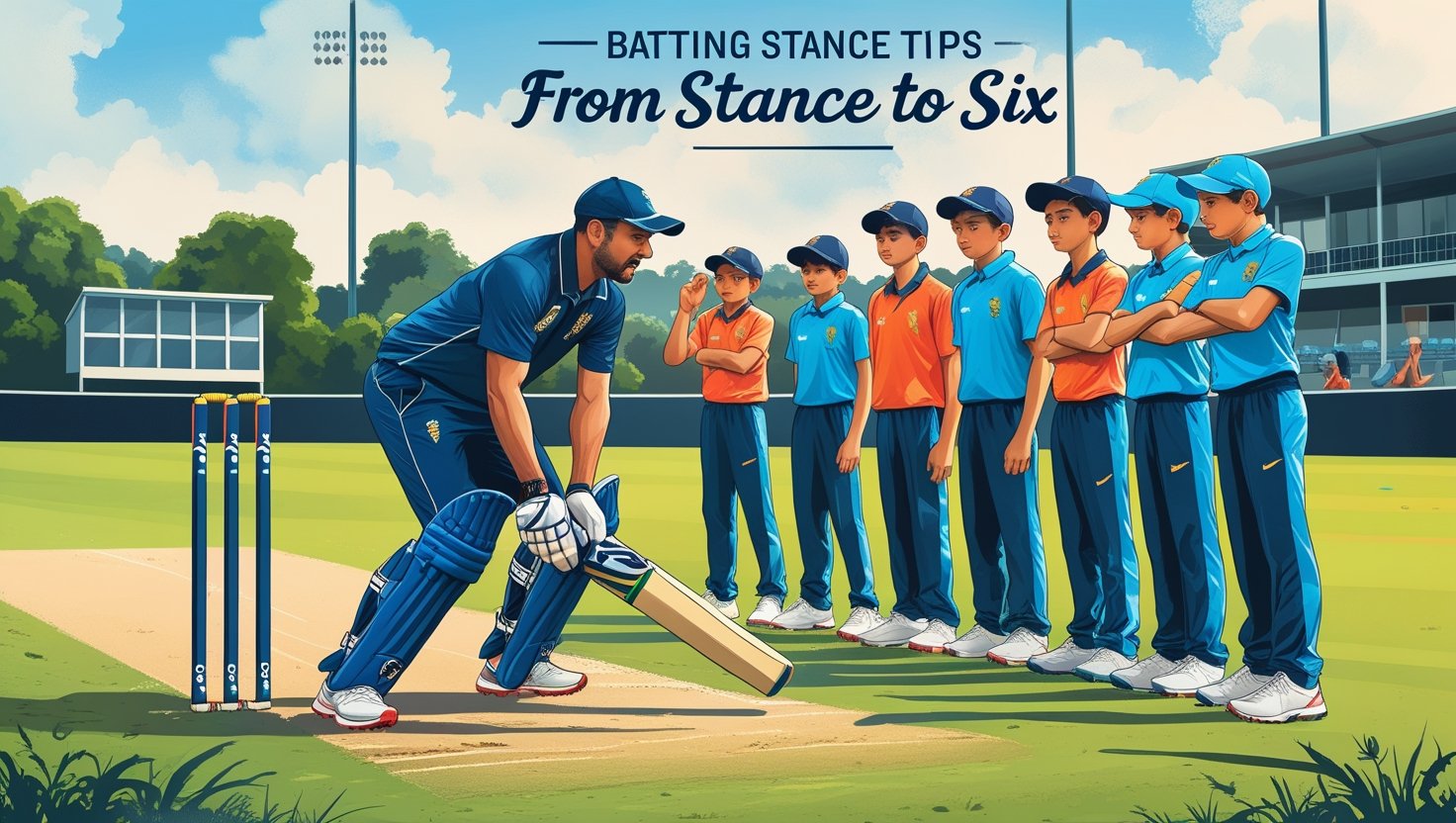
Whenever you hit a strong shot in cricket, be it a cover drive or a six, its base is always the stance. The meaning of stance is how you stand on a crease, your balance, feet position, and body’s readiness. Many beginners make the mistake of focusing only on their shots and ignoring their stance. But if the stance is not correct, then timing, power, and placement of the shot will never be perfect. The goal of this article is to provide you with simple, step-by-step tips so that you can complete your journey from a still stance to success. Get ready, because the game is about to change.
The Power of a Perfect Stance:
When you bat, then stance is not a style of standing. This gives full control of the body and preparation. A better stance means the right combination of balance, focus, and power. If your stance is strong, then you can play your shots easily, whether the ball is fast or a spinner’s tricky delivery.
Stability = Control:
- When your body is balanced, your shot is in control. Do not move too much, do not fall, just a solid game.
Feet Shoulder-Width Apart, Knees Slightly Bent:
- Shoulder-width distance between your two feet, and a little bend of the knees, this keeps you flexible and ready for every shot.
Head Still, Eyes Level:
- Not just eyes, it is important for the head to be still to see the ball. If the head moves, the judgment will be bad.
Alignment of Bat, Hands, and Shoulders:
- Keep the bat and hands in such a way that your shoulders are in a natural position, and the bat does not slip. This is a checklist that should be in mind before every shot.
Types of Batting Stances and Their Use Cases:
Every batsman doesn’t use the same stance every time. Because they have to change their stance according to bowling style and pitch conditions. There are 3 basic types of stance: Open, Close, and Neutral. Every stance has its own advantage. You will have to understand which stance to use at what time, so that you can make better decisions on the crease. This improves your shot selection and timing.
Open Stance:
- When your front foot is slightly towards the off-side (open).
- Advantage: It is easy to see and track the ball of fast bowlers well.
- It helps in playing shots towards weaknesses.
Closed Stance:
- When your front foot is slightly more across (towards the inside).
- Advantage: The defense is strong against spin bowlers.
- You can play more grounded shots.
Neutral Stance:
- The most balanced stance, both pairs are almost straight, in a neutral position.
- Advantage: Adaptable for every type of bowling, defensive as well as attacking.
How to Choose?
- If the pitch is fast, then an open stance will be helpful.
- If the spinner is turning too much, then a closed stance is better.
- If it is a normal pitch and there is mixed bowling, then a neutral stance is the best option.
Footwork Begins with Stance:
Footwork is vital while batting, but it starts with a good stance. If your starting position is wrong, you won’t be able to reach the ball properly. The first step out of your stance is called your stride, and it determines whether or not your shot will be in balance. Good footwork doesn’t mean you’re just moving quickly, you have to maintain control with light movement. Some drills teach you how to do the correct footwork from your stance to the ball.
Good footwork starts with the stance:
- If the stance is strong, your movement will be natural and in balance.
Stance to stride:
- When the ball is released, your first step (or stride) is very important in shot selection.
- This should be practiced in the nets.
Important drills:
- Shadow footwork (practice without the ball)
- Cone drill (for directional steps)
- Bat-and-step drill (coordinate the movement of the bat along with the stance)
Stay light on your feet:
- Distribute your weight evenly between both pairs, so as not to lose balance
- Avoid being too jumpy, movements should be smooth and sharp.
Common Stance Mistakes That Kill Your Timing:
If your stance has even a small mistake, then your entire shot can be spoiled. Standing too straight or bending too much affects your backlift and reach, either your bat falls prematurely or doesn’t reach the ball properly. If your eyes are closed or your head is shaking, you can’t focus on the ball. Likewise, if your knees aren’t moving at all or your feet are frozen, your body doesn’t have rhythm, which affects both power and placement. Back and general mistakes, holding the bat too tightly, make your strokes stiff and slow.
Too Much Straightness or Too Much Bending:
- Your bat either comes too fast or your reach is less.
- Backlift gets disturbed.
Head Shaking or Eyes Not Being Focused:
- Ball’s direction is missed.
- Reaction time becomes slow.
Frozen Feet or Locked Knees:
- If there is no movement, then there is no timing.
- Both power and control are lost in the shot.
Holding the Bat Too Tight:
- Wrists and arms are not flexible.
- Stroke feels slow and hard, it is not smooth.
Drills to Train a Solid, Game-Ready Stance:
A good stance doesn’t just come from a theory, for this, you have to perform drills every day. The first and easiest technique is mirror practice, look at yourself in front of the mirror and check your body alignment and head position, so that your body is perfectly ready before every shot. Then comes shadow batting, in which you test your stance and balance against a tennis ball without hitting the ball. Another best drill is the bat behind the back, in which you keep the bat on the back so that the spine remains straight and your posture improves. The last drill is a jump-stance drill, in this, you take a slight jump and immediately come into stance, due to which the stance gets ready even under the pressure of the match.
Mirror practice:
- Check the alignment of your shoulders, head, and feet.
- Mistakes are immediately noticed.
Shadow batting with a tennis ball:
- Test your stance and balance without hitting the ball.
- Feel the body movement without distraction.
Bat behind the back drill:
- Keeping the bat on the back keeps the spine straight.
- Posture and upright position improve.
Jump-stance drill:
- Learn to come into stance immediately by taking a slight jump.
- Reflexes and readiness improve.
How Pros Use Their Stance as a Weapon:
Top-level batsmen like Virat Kohli, Babar Azam, and Steve Smith don’t understand their stance to be just loose, they use it as a tactical weapon. Each player’s stance is according to his style of playing. Kohli’s stance is steady and composed, which remains stable even under pressure. Babar Azam’s stance is elegant and balanced, which helps him with timing and control. Steve Smith uses a slightly unique stance, but his body movement is perfect during the shot.
When the pressure increases, these players adjust their stance slightly, becoming a little closer or opening up to confuse the bowler. Power hitters (like Andre Russell) use a wide and aggressive stance, while anchor players (like Kane Williamson) prefer a calm and neutral stance. You can learn a lot from these pros’ styles, like balance, calmness, and adjusting stance according to the situation.
Virat Kohli:
- Stable and calm stance.
- Remains focused even under pressure.
Babar Azam:
- Elegant, balanced stance.
- Gives a perfect base for timing and placement.
Steve Smith:
- Slightly awkward stance, but full control during the shot.
- There is a lot of movement, but it is effective.
Adjustments during pressure:
- The stance is made slightly open or closed so that the bowler gets confused.
- These small changes make a difference in their performance.
Power hitters vs. Anchor players:
- Power hitters (like Russell): Wide, aggressive stance.
- Anchor players (like Williamson): Calm, composed stance.
What you can learn:
- Pick up some small things from each player, like balance, focus, and adaptability.
From Stance to Six:
If you want your shot to go straight across the boundary, the strength of the hands alone is not enough, the role of the lower body is most important. When your stance is strong, power is generated from your legs and hips. Then comes the backlift (the way to take the bat backwards), hip rotation, and hand speed, these three things together bring full force to the shot.
When you hit the ball, the angle of the bat also needs to be perfect, neither too upright nor too flat. If the bat is in the right position at the point of impact, the ball can easily go into the air. A useful drill for developing this skill is: “Stance to lofted drive“, in which you first take a stance, then fire a lofted (in the air) shot in a controlled manner, focusing on timing and power.
Power from the Lower body:
- Strong legs and a stable base give real power to the shot.
- Don’t just use your arms, involve your full body.
Backlift, hip rotation, hand speed:
- Backlift gives momentum.
- Hip rotation releases power from the core.
- If hands are fast, the timing is perfect.
Bat angle:
- The correct angle is important to lift the ball.
- At the impact point, the face of the bat should be slightly towards the sky.
Practice drill – Stance to Lofted Drive:
- Take a stance first, then hit the shot in a controlled manner.
- Focus on timing, foot movement, and bat swing.
Conclusion:
Every great innings starts with a perfect stance. When you master your stance, you gain consistency, control, and confidence in your game. Whether you’re playing front-foot defense or hitting a six, everything starts with the stance. That’s why it’s important that you practice daily, review your body position, and keep refining even small mistakes. A good stance is not just a style, but the foundation of your performance. If you want to become a top-level batter, never stop focusing on your stance.
FAQs:
Q1: What is the ideal batting stance for beginners?
A neutral stance gives better balance and adaptability.
Q2: Should the stance change depending on the bowler?
Yes, minor adjustments help in reacting better to pace or spin.
Q3: Can I copy a professional player’s stance?
You can learn from them, but customize it to your body and comfort.
Q4: How can I know if my stance is wrong?
If you struggle with timing, balance, or footwork, check your stance first.
Q5: Is batting stance important in tennis-ball cricket too?
Absolutely, a proper stance helps with power and control in all formats.